A convincing listing alone cannot establish that a property or representative is genuine. A disciplined approach to avoiding property scams in the UAE starts with verifying the listing, the person handling the transaction, and the documents before any funds move.
Caution is especially important when someone pressures you to pay quickly or makes it difficult to arrange a viewing. Careful checks can help you spot warning signs, whether you are considering a ready property or an off-plan investment.
This guide explains how to assess suspicious listings, verify brokers and developers through relevant Dubai channels, and check project registration and escrow arrangements. It also covers practical checks for property documents and payment requests, helping you make an informed decision before committing.
Key Takeaways
- Treat unusually low prices, blocked viewings, rushed payment requests, and mismatched documents as reasons to pause and investigate.
- Check a Dubai agent’s RERA broker ID and verify that the brokerage is properly connected to the transaction.
- For ready properties, confirm ownership details through Dubai’s official property channels before transferring funds.
- Before committing to an off-plan project, check its registration and ensure payments go through the approved escrow channel.
- Review a developer’s completed projects and construction record to make a more informed investment decision.
Table of Contents
1. Fake property listings
A polished listing does not prove that a Dubai property exists or that its advertiser can sell or lease it. Phantom-property scams may use genuine photographs, copied floor plans, or a real address to collect deposits for a unit the advertiser does not own or manage. Compare the address, building, unit details, images, and advertised terms across listings. A luxury villa priced 30% below the market average warrants close scrutiny. These checks are a practical starting point for avoiding property scams in the UAE.
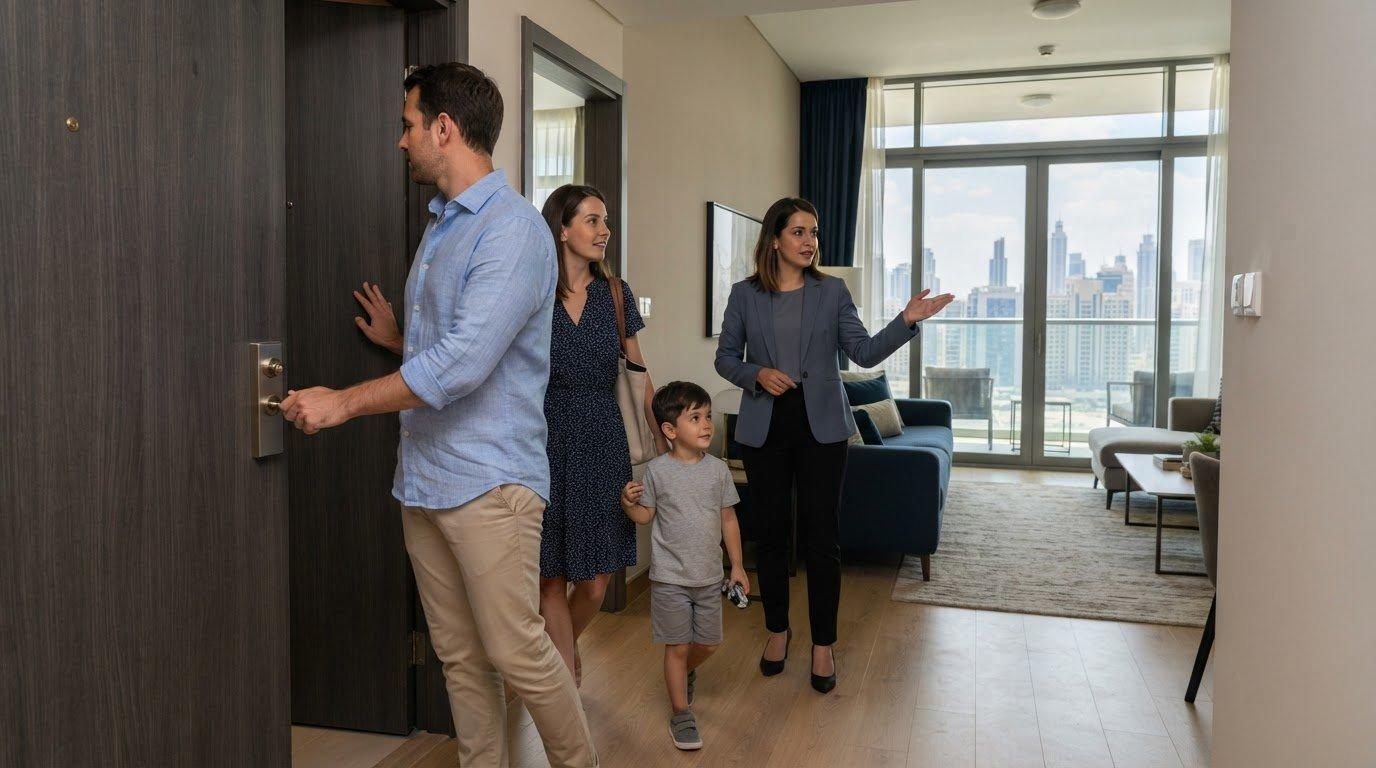
Arrange a physical viewing before paying, then compare the unit with the listing and documents. If you are abroad, ask a trusted local representative to visit and check that the address, layout, and visible features match. Brochures and 360-degree room images can help you assess a property remotely, but they cannot prove ownership or an advertiser’s authority. A real unit and access to it do not establish the right to sign a lease or collect money.
Digital phishing messages can imitate a broker, property company, or bank with familiar branding, convincing email addresses, and official-looking fine print. Treat unexpected links and requests for financial details with caution. Legitimate banks and financial services companies may request personal financial particulars through secure channels, but verify any request directly with the institution using independently obtained contact details. Don’t open payment links from unsolicited messages.
Fake holiday-home rental listings may obscure who operates the property. Holiday-home listings in Dubai and Abu Dhabi require a holiday-home licence number. Confirm the operator and applicable local requirements, since building access alone does not establish the right to offer short-term accommodation. For an ordinary rental, view the property and receive a signed agreement and a copy of the landlord’s or agent’s Emirates ID before paying a deposit.
A UAE sale or rental contract should identify the parties, property, agreed amount, payment terms, dates, and signatures. Dubai rental contracts should be registered through Ejari, while sale transactions proceed through Dubai Land Department channels. Check any official-looking document with the authority, company, or person that issued it. A document’s appearance alone does not prove it is genuine.
Common scams include phantom listings, forged ownership or tenancy documents, fake rental deposits, and requests to pay an unrelated recipient. Purchase costs may include agency commission, VAT on that commission, and the Dubai Land Department transfer fee. Confirm the applicable amounts and payment responsibilities in the transaction documents before proceeding. Follow the agreed payment procedure, use traceable payments, and obtain a receipt that identifies the property and purpose of the payment.
2. How Can You Check for Real Estate Scams in Dubai?
A convincing website cannot prove a broker’s authority. Scammers may use polished websites, copied branding, and professional-looking documents to appear legitimate. Treat online information as a starting point, not proof. Before making a decision or signing a contract, verify the agent, brokerage, property records, and payment instructions through relevant official channels.
Dubai agents must hold a valid RERA broker ID, and buyers can check registration through Dubai Land Department channels. Trakheesi is identified as a platform for verifying agent and broker licences. Match the broker’s name and details with the brokerage handling the transaction, then contact the firm using independently obtained details. A genuine listing or property viewing does not, by itself, establish authority to sign an agreement or receive funds.
For a ready property, compare the seller’s ownership details with Dubai Land Department records. Dubai REST provides property verification, title deed, and ownership information. Check that the property details and owner’s identity match the transaction documents. If a representative acts under a power of attorney, verify the document and the representative’s authority with the relevant issuing authority. A scanned deed or power of attorney alone does not prove it remains valid or applies to the proposed sale.
Before paying a deposit, view the property and verify its ownership, the advertiser’s authority, and the broker’s credentials. Make sure the contract identifies the correct parties and property, and that payment goes to the authorised recipient named in the transaction documents. Pause if names, account details, or terms change without a clear, documented explanation.
For an off-plan purchase, confirm the developer and project registration through Dubai’s property verification channels. The Real Estate Regulatory Agency oversees broker licensing, project registration, and escrow compliance. Off-plan projects in Dubai must be registered and linked to escrow accounts. Payments should go through approved escrow channels, not an individual’s personal account. Treat any request to bypass those channels as a serious warning sign.
Dubai REST and Trakheesi are used for different checks: use Dubai REST for property and ownership information, and Trakheesi for agent or broker licensing. An internet search may not reveal who controls a sophisticated website or whether its documents are genuine. Cross-check details against official records and the relevant brokerage before transferring funds.
3. Unlicensed agents and fraudulent brokerages
A professional appearance does not establish that an agent can represent a property transaction. Requirements for real estate professionals can vary by emirate and role, so do not assume a single UAE-wide rule applies. For Dubai transactions in 2026, check current Dubai Land Department requirements for the agent’s registration and brokerage relationship. Confirm the relevant details before sharing documents, signing, or paying.
In Dubai, check the agent’s RERA broker ID through official Dubai Land Department channels. Match the name and identifying details on the registration card to the person handling the transaction. Then verify that the brokerage named in the paperwork is the firm employing or authorising that agent. A card belonging to someone else does not prove the representative’s authority.
Check the brokerage’s role in writing. The firm’s name on the agreement, correspondence, and payment instructions should be consistent. Before paying professional fees, check the agreement and confirm the payment recipient with the brokerage through independently obtained contact details. If the recipient changes or the agent requests a transfer without supporting paperwork, pause and establish the reason before proceeding.
A representative’s authority may be limited. Someone permitted to show a property may not be authorised to sign a lease, collect rent, or negotiate a sale for its owner. Ask for documents establishing that person’s role, then verify them with the named owner or brokerage using independently obtained contact details. Confirm that the property, parties, dates, and permitted actions align across the documents.
A responsible broker should welcome clear transaction records and explain who represents each party. A broker who presents properties from several companies may offer a broader view than someone presenting only one builder’s projects. This is worth considering, but it does not prove legitimacy: still verify the agent’s credentials, the brokerage, and the specific property through appropriate channels.
Watch for pressure to transfer money quickly, vague explanations about registration, incomplete paperwork, or claims that verification is unnecessary. These signals do not prove fraud, but they are reasons to pause until the agent’s identity, brokerage authority, and payment recipient are clear. Keep messages and payment instructions so you can spot changes in names or terms.
If concerns remain, do not send further funds. Request official documentation and report suspected property fraud to the Dubai Land Department or RERA. A legitimate broker should be able to present relevant credentials and transaction paperwork without directing payment to an unrelated person. Base your decision on documented details, not a polished profile or online search result.
4. Checking developer track records and completed projects
Review a developer’s completed work before committing to an off-plan purchase. Identify projects delivered under the same legal developer name, then inspect a completed property in person. Compare the building’s visible condition, shared areas, and finished units with the quality shown in current sales materials. A polished showroom alone cannot demonstrate how a completed project performs.
Make the comparison specific. Match each completed project’s name and location to the developer’s portfolio, then note what you observe on site. For example, examine whether entrances, lifts, corridors, and exterior finishes appear maintained. If access is available, compare a finished unit’s layout and fixtures with the features described for the proposed purchase. Record differences and ask for clear written explanations.
Look beyond appearance. Ask the developer to identify completed projects, handover records, and relevant construction updates for the project you are considering. Compare the stated milestones with dated site images or an in-person site visit. For unfinished property in Dubai, check the construction site’s location and boundaries with the dealer. Confirm that the land and project being presented match the documents.
A developer’s track record is more useful when the evidence is consistent. Compare the company name across sales documents, project materials, and payment instructions. If a representative uses a different entity name, ask for the relationship to be documented before proceeding. Keep answers and supporting records with your purchase file, so you can identify later changes to parties, project details, or payment terms.
Be attentive to pressure. A request for additional money after several months without visible construction progress warrants a pause and careful review. Compare the request with the signed purchase agreement, stated payment milestones, and project information. Don’t assume a new payment demand is routine simply because it arrives through a familiar contact or uses official-looking branding.
Separate a developer’s marketing from evidence of delivery. Brochures and renderings describe an intended finish; completed homes show what the developer has delivered. Buyers can visit earlier projects, inspect their condition, and compare visible features with the original descriptions. If the developer cannot identify completed work or provide coherent project records, treat that gap as a decision risk, not proof of misconduct.
Before paying deposits or later instalments, keep the developer’s project name, site location, signed agreement, milestone schedule, and payment recipient together in one file. Check that each detail matches across the documents and the information presented by the dealer. This record gives you a clear basis for questioning inconsistencies and deciding whether the proposed investment merits further review.
5. Checking project registration and escrow accounts
For an off-plan purchase, confirm the project appears in the relevant emirate’s official property records before sending payment. For an off-plan purchase, check that the project’s registration and payment arrangements are documented before transferring funds. Escrow accounts are mandatory for off-plan projects in Dubai and Abu Dhabi. Registration helps distinguish a documented development from one represented only through sales material, online listings, or an agent’s claims.
In Dubai, use Dubai REST to check off-plan property details. For Abu Dhabi, check property information and relevant documents against official records before proceeding. Match the project name, developer, unit details, and location in the official record against the reservation documents and sale contract. If they do not match, ask for clarification before proceeding.
Check payment instructions just as carefully. The project’s escrow details should match the registered project and payment paperwork. Confirm the account name, project reference, and beneficiary through official transaction documents, not solely through an email or message from an agent. Off-plan payments should go through approved escrow channels, not to an individual’s personal account.
Scammers may use a genuine developer’s name while changing the payment recipient or circulating altered account details. Treat new payment requests, especially those accompanied by pressure to act quickly, as a reason to pause. Contact the developer using independently obtained contact details and ask it to confirm the account and payment milestone. Keep the response with the signed contract and transaction records.
Review the contract’s payment schedule before each transfer. Compare the amount requested and the stated milestone with the signed terms and project records. If construction appears stalled or an agent requests additional money outside the agreed schedule, preserve the message and supporting documents. Don’t assume a familiar logo or earlier payment proves a new request is legitimate.
These checks differ from those for a rental transaction. A rental deposit does not establish an off-plan project’s registration or validate its escrow arrangements. Keep sale and rental paperwork separate, and verify the correct process for the specific property and emirate. For buyers, recording each check creates a clear trail: official project registration, escrow details, signed terms, payment recipient, and receipt.
Before committing to an off-plan investment, make sure the project record, escrow details, contract, and payment schedule align. Pause if the documents conflict or a payment request directs funds outside the approved channel.
Terra Firma
Terra Firma helps buyers assess UAE property opportunities and make clearer transaction decisions. Turn to the team when you are weighing a ready property, an off-plan purchase, or a commercial investment and want guidance on the acquisition process and relevant documentation.
Its portfolio includes properties for sale, off-plan properties, commercial properties, and retail spaces across the Emirates. This is a practical next step after reviewing listing, broker, developer, registration, and escrow checks, particularly when narrowing options to suit your investment or business needs.
For a considered discussion about your UAE property plans, contact Terra Firma.
Make Your Next Property Decision Deliberately
Set a clear standard for what you need to see before committing to a Dubai property. Avoiding property scams in the UAE is not only about spotting warning signs; it also means allowing enough time to assess whether an opportunity fits your priorities, intended use, and investment horizon.
Before moving forward, define the questions that matter most to your decision. Consider how the property supports your business or personal plans, what information you need to feel comfortable proceeding, and which unresolved points would lead you to pause. Keeping these criteria in view can help you distinguish a considered opportunity from one driven by pressure.
Terra Firma can help you explore your next property decision with clear, relevant guidance. Contact us to arrange a private consultation about your requirements and the path ahead.
Contact Terra Firma for current availability, pricing, and floor plans and take your next step with confidence.
Frequently Asked Questions
Are Real Estate Scams Common in Dubai?
Buyers in Dubai can face misleading offers or forged documents. A professional-looking website or confident phone call does not establish that a transaction is legitimate. Treat pressure to transfer funds, unusual payment instructions, or discouragement from independent checks as reasons to pause. Verify the people and records connected to the specific property before committing.
How can you verify a UAE real estate agent and brokerage are licensed?
In Dubai, verify the agent’s RERA broker ID through official Dubai Land Department channels, and check that the named brokerage is properly connected to the transaction. Compare the agent’s identity and brokerage details with the paperwork. Contact the firm using independently obtained details, rather than relying only on a number in an unsolicited message. For Abu Dhabi property matters, DMT Smart Hub provides checks for property information, permits, and broker IDs.
How do you check whether a UAE property is registered and the seller is its legal owner?
For a ready property in Dubai, use Dubai REST to review available title deed and ownership information, then compare the recorded owner and property details with the sale documents. If a representative is handling the sale, establish their authority and verify the supporting document with its issuer. Don’t rely on a listing, copied deed, or access to the unit alone as proof of ownership or authority to sell.
What are the UAE rules for buying off-plan property and checking developer registration?
For Dubai off-plan purchases, confirm the project’s registration and link to an escrow account through official property channels. Dubai REST supports Dubai property checks; DMT Smart Hub provides relevant property information in Abu Dhabi. Off-plan projects in Dubai and Abu Dhabi require escrow accounts. Match the project, developer, unit, and payment details in the official record against the sale documents, and send payments only through approved escrow channels.
How can you safely verify bank details and avoid payment fraud in a UAE property transaction?
Confirm the recipient and account details against the signed transaction documents, then verify changed instructions using independently obtained contact details. Pay professional fees to the licensed brokerage firm, not an agent’s personal account, and use traceable payments with official receipts. Don’t transfer cryptocurrency to an agent’s personal wallet. If bank details change unexpectedly, pause the transfer and contact your bank promptly if funds have already been sent.
How can you report property fraud in the UAE, and which authorities handle complaints?
If you suspect property fraud in Dubai, pause the transaction, stop further transfers, preserve messages and payment evidence, and contact your bank promptly after a suspicious transfer. Report property concerns to the Dubai Land Department or RERA. Keep copies of contracts, account instructions, receipts, and communications so you can explain the issue clearly. For a suspected rental scam, retain the listing and correspondence alongside the transaction record.